Nightmarks
A SaaS product I designed, built, and now run. A custom map and database of the world's recorded supernatural encounters.
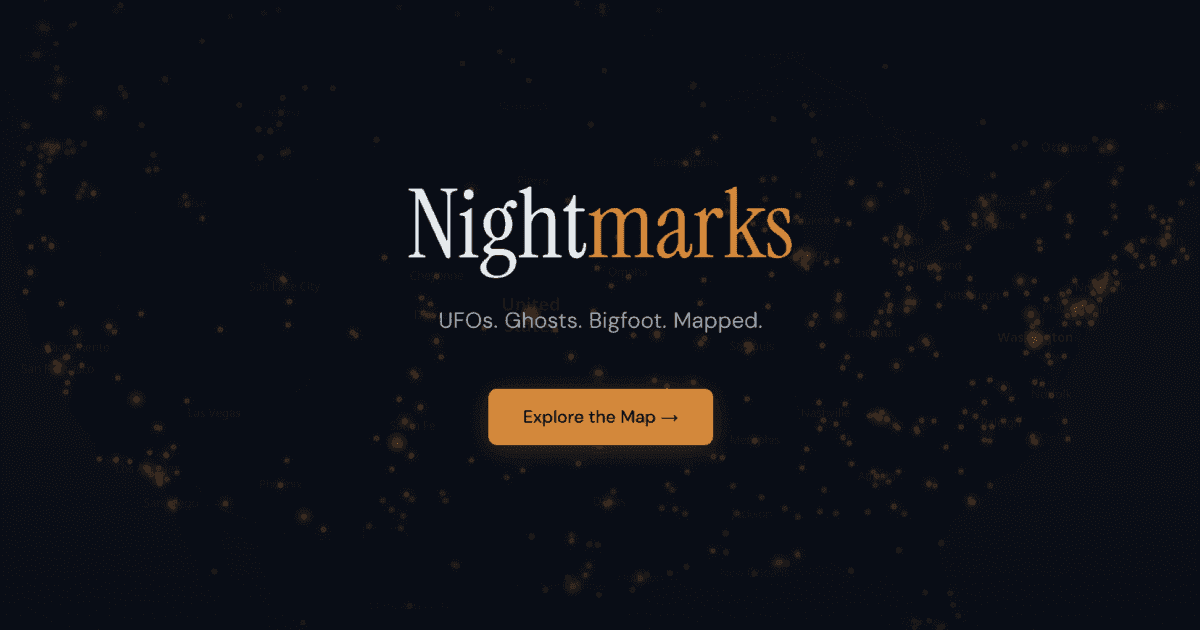
Nightmarks is a SaaS product that maps and catalogs the world's recorded supernatural encounters. UFO sightings, ghost stories, cryptid reports, folklore legends — historically scattered across old forums, cryptid wikis, decades of out-of-print books, and regional ghost-hunting blogs. Nightmarks pulls them into a single structured, explorable place — a map, a library, and an editorial layer rolled together, with a paid membership tier on top.
What needed solving.
Two real product problems had to be solved at the same time.
The data problem. Thousands of historical encounters, each with its own shape — dates, locations, witnesses, categories, credibility tiers — needed a schema that could hold them without flattening the details that make each one interesting. Map-able locations were essential, but so was honoring the fact that some encounters are documented to a street corner and others exist only as 'somewhere in Hertfordshire, 1678.'
The credibility problem. A database of supernatural encounters can't pretend everything in it is verified, and it can't pretend everything is fiction. A 2024 multi-witness UFO sighting with radar correlation is not the same artifact as a 17th-century woodcut about a devil-mowed field. Both deserve a place in the catalog. They don't deserve the same visual weight on the map, in search, or in editorial surfaces.
How the work was structured.
The build sat at the intersection of three different things: a content-heavy database, an interactive map, and a SaaS surface — accounts, paid tier, editorial layer. A few decisions shaped the outcome.
Map-first development. The explore view is the core experience, so I built it first and validated the data shape against it. Anything that couldn't render meaningfully on the map was a signal the schema needed rethinking before adding more entries.
Credibility tiers as a first-class filter. Verified, historical, user-reported, and unverified each get their own surface in the UI — as filters, as a date-range default, and as visual weight on the map itself. The UX argues that credibility is part of the data, not a footnote.
An editorial layer on top of the database. 'Nightmark of the Week,' curated regional collections, and a guides section give the product reasons to come back beyond a single search. The database is the substrate; the editorial layer is the habit loop.
A paid tier built around the data, not paywalled at the door. The free product is genuinely useful — full map, full database, full reports. The Explorer Pass adds advanced query tools and power-user features. Affiliate integrations for recommended gear and reading, plus curated partnerships with paranormal tour operators, round out the revenue legs.
The AI-accelerated workflow took typing speed and tedious implementation off the critical path. Architecture, schema, content model, and product calls were all still mine to make — those are the actual work. They could move at full speed because the bottleneck wasn't in the code, it was in the decisions.
What changed.
Nightmarks is live at nightmarks.com. The product today includes an interactive global map filtering across five categories — Cryptids, UFOs/UAPs, Ghosts & Hauntings, Unexplained Phenomena, and Folklore & Legends — with individual report pages, structured metadata, and location context for each entry.
Beyond the map: a 'Nightmark of the Week' editorial rotation, Collections and Tours surfaces, a Community section for user contribution, a guides section for field investigators, and an Explorer Pass premium tier with advanced query tools.
Revenue arrives through three legs: paid memberships, affiliate integrations, and curated partnerships with paranormal tour operators. The database is in active growth, and the SaaS surface is in place to scale across all three as the product matures.
“Building the explore map first — rather than accounts, admin, and infrastructure first — kept me honest about whether I was making progress on the thing users actually touch. The pattern I'll keep: core loop first, supporting scaffolding second. The pattern I'll drop: trying to fully scope 'community submissions' before the product is real enough for users to react to. Some systems need the surrounding product to exist before their right shape is clear. Nightmarks is the first of several SaaS products I plan to build and run. The technical patterns, the editorial-on-top-of-data structure, and the workflow that made it possible all carry forward.”
Working on something similar? Here’s the tier.
Extended Build — A larger build with deeper scope, advanced interactions, and more thorough SEO and AEO work. 6–8 weeks. Fixed price.